OpenAI-Compatible APIs: The Easiest Way to Switch Between AI Models
OpenAI-Compatible APIs: The Easiest Way to Switch Between AI Models
Artificial Intelligence is evolving at an incredible pace. New models, providers, and inference platforms appear almost every month. While this rapid innovation is exciting, it creates a challenge for developers: how do you build applications that aren't tied to a single AI provider?
The answer is simple: OpenAI-Compatible APIs.
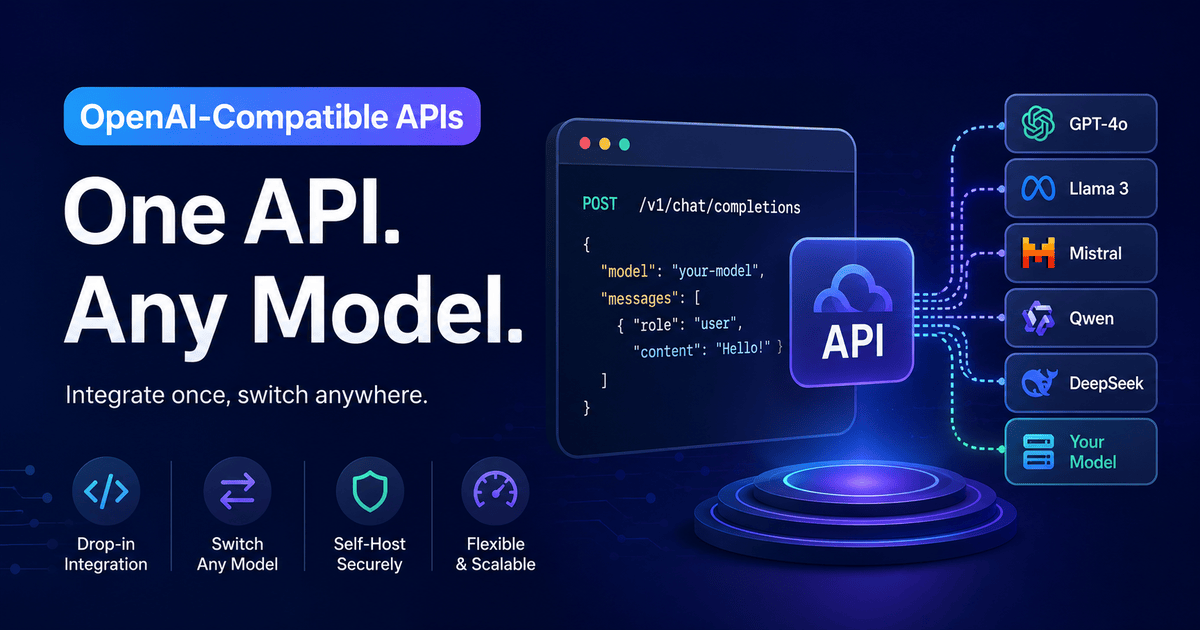
By adopting a common API format, developers can switch between models, self-host their infrastructure, or move to different providers without rewriting their entire application stack.
In this guide, we'll explore what OpenAI-compatible APIs are, why they matter, and how they can help you future-proof your AI applications.
What Is an OpenAI-Compatible API?
An OpenAI-compatible API is an API that follows the same request and response structure popularized by OpenAI's developer platform.
Instead of creating a custom integration for every AI provider, developers can use a familiar format that works across multiple systems.
This means applications built for OpenAI can often communicate with:
- Self-hosted open-source models
- Dedicated inference servers
- Private enterprise deployments
- Alternative AI providers
- GPU rental infrastructure
without major code changes.
Think of it as a universal adapter for AI applications.
Why Has It Become So Popular?
When OpenAI released ChatGPT and its developer APIs, thousands of tools, frameworks, and SDKs adopted the same interface.
Today, many popular AI development tools expect:
- Chat completion endpoints
- Streaming responses
- Model listing APIs
- Standard authentication headers
As a result, OpenAI's API format has become one of the most widely supported interfaces in the AI ecosystem.
This widespread adoption created a powerful network effect: developers learned one API and could reuse that knowledge almost everywhere.
The Problem With Vendor Lock-In
Imagine building an application directly around a single AI provider.
What happens if:
- Pricing increases?
- A better model becomes available?
- You need stricter data privacy?
- You want to run models on your own GPUs?
Without a compatibility layer, migration can require significant engineering effort.
OpenAI-compatible APIs reduce this friction by allowing applications to swap the backend while keeping the frontend integration unchanged.
Instead of rewriting your code, you simply change the API endpoint.
How OpenAI Compatibility Works
Most compatible servers expose endpoints that closely resemble OpenAI's API structure.
A typical request includes:
{
  "model": "your-model",
  "messages": [
    {
      "role": "user",
      "content": "Hello"
    }
  ]
}
The server processes the request and returns a response in a familiar format.
Because the schema remains consistent, existing SDKs and integrations continue working with minimal adjustments.
Connecting to a Different Provider
One of the biggest advantages of compatibility is portability.
For example, if your application currently uses the OpenAI SDK, you can often redirect requests to a different endpoint:
from openai import OpenAI

client = OpenAI(
    base_url="https://api.your-provider.com/v1",
    api_key="YOUR_API_KEY"
)

response = client.chat.completions.create(
    model="my-model",
    messages=[
        {"role": "user", "content": "Explain AI inference."}
    ]
)

print(response.choices[0].message.content)
The application logic stays largely the same.
Only the endpoint and model name change.
Direct API Requests
If you're not using an SDK, you can communicate directly with the server using HTTP requests.
Example:
curl https://api.your-provider.com/v1/chat/completions \
-H "Authorization: Bearer YOUR_API_KEY" \
-H "Content-Type: application/json" \
-d '{
  "model": "my-model",
  "messages": [
    {
      "role": "user",
      "content": "What is an OpenAI-compatible API?"
    }
  ]
}'
This flexibility makes integration possible from virtually any programming language.
Real-Time Streaming Responses
Modern AI applications often display text as it's being generated.
Streaming allows users to see responses appear token-by-token rather than waiting for the entire completion.
Benefits include:
- Faster perceived performance
- Improved user experience
- Better conversational interfaces
- Reduced waiting time
Most OpenAI-compatible servers support streaming, making it easier to build responsive chat applications.
Discovering Available Models
Many AI servers expose a model discovery endpoint.
This allows applications to automatically retrieve supported model names instead of hardcoding them.
Example workflow:
- Query the models endpoint.
- Retrieve available model IDs.
- Present them to users.
- Send requests using the selected model.
This becomes especially useful when hosting multiple LLMs behind a single API.
Self-Hosting with OpenAI Compatibility
One of the strongest reasons to adopt this approach is self-hosting.
Organizations can run:
- Llama models
- Qwen models
- DeepSeek models
- Mistral models
- Specialized fine-tuned models
on their own infrastructure while maintaining compatibility with existing applications.
This provides:
- Greater control
- Data privacy
- Infrastructure ownership
- Custom deployment options
without forcing developers to learn a completely new API.
Does Compatibility Reduce AI Costs?
Not directly.
The API format itself doesn't change how much inference costs.
The real savings come from where the model is running.
Using Hosted APIs
When using third-party providers, pricing is typically based on:
- Input tokens
- Output tokens
- Requests
Using Self-Hosted Models
When self-hosting, costs shift toward:
- GPU rental
- Cloud infrastructure
- Storage
- Networking
For teams with steady traffic, self-hosting can often become more economical than paying per-token pricing.
The OpenAI-compatible interface simply makes the transition easier.
Benefits for Developers
Adopting OpenAI-compatible APIs offers several advantages:
Faster Development
Reuse existing SDKs and integrations without learning a new interface.
Easier Migration
Move between providers with minimal application changes.
Infrastructure Flexibility
Choose between hosted, hybrid, or self-hosted deployments.
Ecosystem Compatibility
Work seamlessly with frameworks, tools, and agent platforms that already support OpenAI's API format.
Future-Proof Architecture
Avoid becoming dependent on a single vendor.
Why Open LLM Buddy Supports OpenAI Compatibility
At Open LLM Buddy, we believe developers should have the freedom to choose the best model and infrastructure for their needs.
OpenAI compatibility enables:
- Simple model switching
- Faster integrations
- Reduced migration effort
- Greater deployment flexibility
Whether you're experimenting with open-source models, running workloads on rented GPUs, or deploying private AI infrastructure, maintaining a familiar API interface helps keep your development process efficient and scalable.
Final Thoughts
The AI ecosystem is moving too quickly for applications to be tightly coupled to a single provider.
OpenAI-compatible APIs provide a practical layer of abstraction that allows developers to build once and deploy anywhere.
By separating your application logic from the underlying model provider, you gain flexibility, portability, and long-term control over your AI stack.
As more organizations adopt open-source models and self-hosted inference, OpenAI compatibility is quickly becoming one of the most important standards in modern AI development.