Is Gemma 4 26B Good for RAG? The Honest Production Truth
Is Gemma 4 26B Good for RAG? The Honest Production Truth
Most AI systems have a dangerous habit: when they don't know the answer, they make something up. For a customer support bot or an internal knowledge tool, that's not just annoying — it destroys trust and creates real business problems.
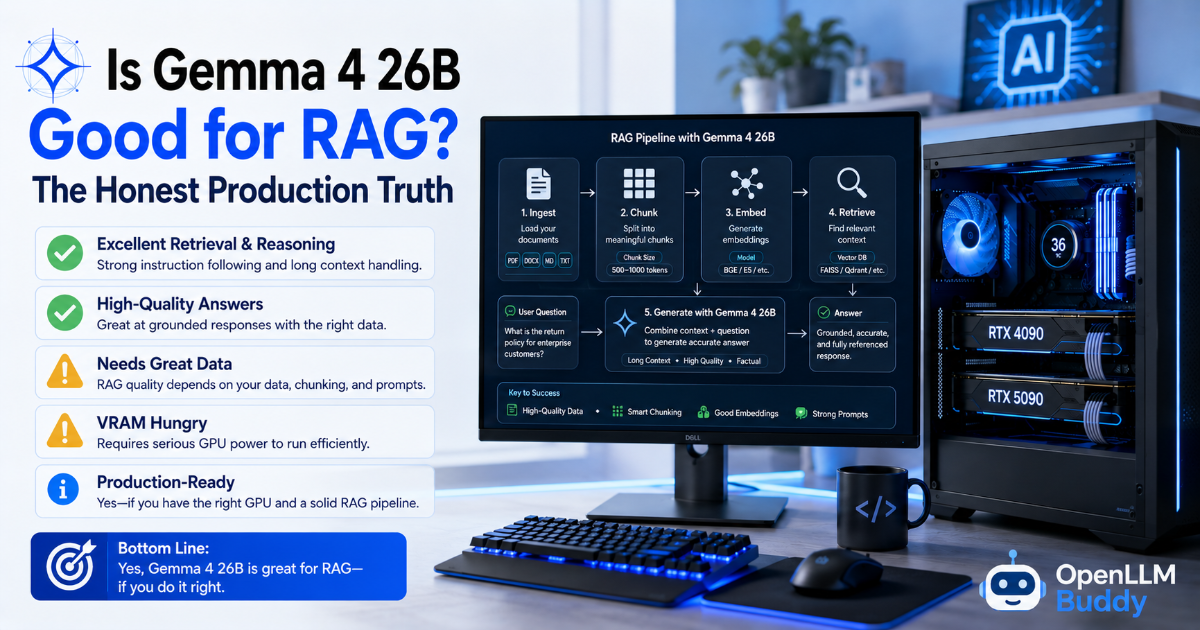
RAG is the fix. It stands for Retrieval-Augmented Generation. Think of it like giving the AI a custom reference textbook before asking it a question. Instead of guessing from memory, the AI reads your actual documents first — your policy manuals, product guides, HR handbooks, legal contracts — and only then gives you an answer. No guessing. No hallucinations. Just answers grounded in your real data.
The question this post answers: is Gemma 4 26B the right brain for your RAG system?
1. The RAG Challenge in 2026
Google DeepMind released Gemma 4 26B in April 2026 under the Apache 2.0 license — completely free for commercial use, no usage restrictions. It uses a Mixture of Experts architecture: 26 billion total parameters stored on disk, but only 3.8 billion activate for each response. It's like having a reference library of 26,000 books where the model pulls only the most relevant 3,800 for each answer — fast and sharp without reading everything every time.
For standard chat tasks, that speed is a nice bonus. For RAG workloads — where the model needs to read through hundreds of pages of documents and extract precise, accurate information — speed and accuracy both matter critically.
The honest question: does a compact, efficient model like this actually have the memory depth and reasoning quality to handle serious enterprise document tasks?
The answer is yes — with some important caveats. Here's the full picture.
2. Where Gemma 4 26B Crushes RAG
The 256K Context Window — Fit an Entire Manual in One Read
The context window is how much text the model can read and keep in its memory at one time. Think of it like a reading desk — some models have a small desk and can only hold a few pages at a time. Gemma 4 26B has an enormous desk: it can hold up to 256,000 tokens at once, which is roughly 200 pages of text.
That means you can pass an entire employee handbook, a full software manual, or a complete legal contract into a single prompt — and the model reads all of it before answering. No chunking required for most real-world documents.
Real-world testing shows Gemma 4 26B maintains 94% text retention accuracy even when reading near its maximum context limit. That means when the answer to a user's question is buried on page 173 of a 180-page manual, the model still finds it — correctly — 94 times out of 100.
For comparison, many smaller models start losing accuracy past 32K tokens. Gemma 4 26B stays sharp all the way through.
Advanced Reasoning — Connecting Dots Across Multiple Sections
Good RAG isn't just finding a sentence that matches a keyword. It's reading section 3, cross-referencing it with the exception clause in section 17, and giving an accurate answer that accounts for both.
Gemma 4 26B scores 88.3% on AIME 2026 — a test of advanced multi-step mathematical and logical reasoning without any external tools. That score isn't just for math problems. It tells you the model can hold multiple pieces of information in its working memory, reason across them, and arrive at a logically sound conclusion.
In a RAG context this means:
- A user asks about a refund eligibility — the model reads the refund policy, the exceptions section, and the product-specific terms, and synthesizes a single correct answer
- A developer asks about an API behavior — the model reads the main documentation page and the deprecation notice from a later section, then gives a complete and current answer
- An HR manager asks about leave policy — the model reconciles the general employee handbook with the department-specific addendum
This kind of multi-source reasoning is exactly what separates a useful RAG system from a glorified keyword search.
The Built-In Thinking Mode — A Native Hallucination Guard
Gemma 4 26B has a native reasoning layer built into its architecture. Before it delivers a final answer, it can write out an internal thought process using <|think|> tags — essentially double-checking its own logic before committing to a response.
In a RAG system, this is powerful because it means the model can flag its own uncertainty. Instead of confidently stating something that isn't supported by the document, it will internally reason through whether the text actually supports the conclusion — and soften or clarify its answer if the evidence is thin.
You can activate this in your system prompt:
system_prompt = """
You are a precise document assistant. Before answering, use your thinking mode
to verify that your answer is directly supported by the provided document.
If the document does not contain a clear answer, say so honestly.
Do not guess or infer beyond what is written.
"""
This single instruction, combined with Gemma 4's native reasoning layer, dramatically reduces hallucinations compared to models that output answers immediately without any internal verification step.
3. The Big Problem — The Multi-Turn Context Tax
Here's where honest RAG deployments hit a wall that most tutorials don't mention.
Passing a 100-page manual into a single fresh prompt works beautifully. The real challenge is multi-turn conversations — the kind of back-and-forth that happens in a real support chat or internal knowledge tool where users ask three, five, or ten follow-up questions in a row.
The Exponential Context Cost
In a standard chat session, every time a user sends a new message, the entire conversation history — including the full document you passed in — gets re-read from scratch. The model doesn't remember the previous turns like a human would. It re-processes everything every single time.
Here's what that means in practice:
- Turn 1: You pass a 50,000-token manual + a 20-token question = 50,020 tokens billed
- Turn 3: Same manual + 2 previous exchanges + new question = 50,200 tokens billed
- Turn 8: Same manual + 7 exchanges + new question = 50,600 tokens billed
With a standard serverless pay-per-token API, you pay for that 50,000-token manual on every single turn of the conversation. A support session with 10 turns means you've paid for that document 10 times.
Real cost example: A 50,000-token company manual read 10 times per conversation, 200 conversations per day, at $15/million input tokens = $1,500/day in document re-ingestion fees alone — before a single output token is counted.
At modest business scale, RAG on per-token infrastructure becomes financially unsustainable.
The VRAM Overload
If you try to self-host to escape per-token billing, large document RAG creates a second problem: memory overflow.
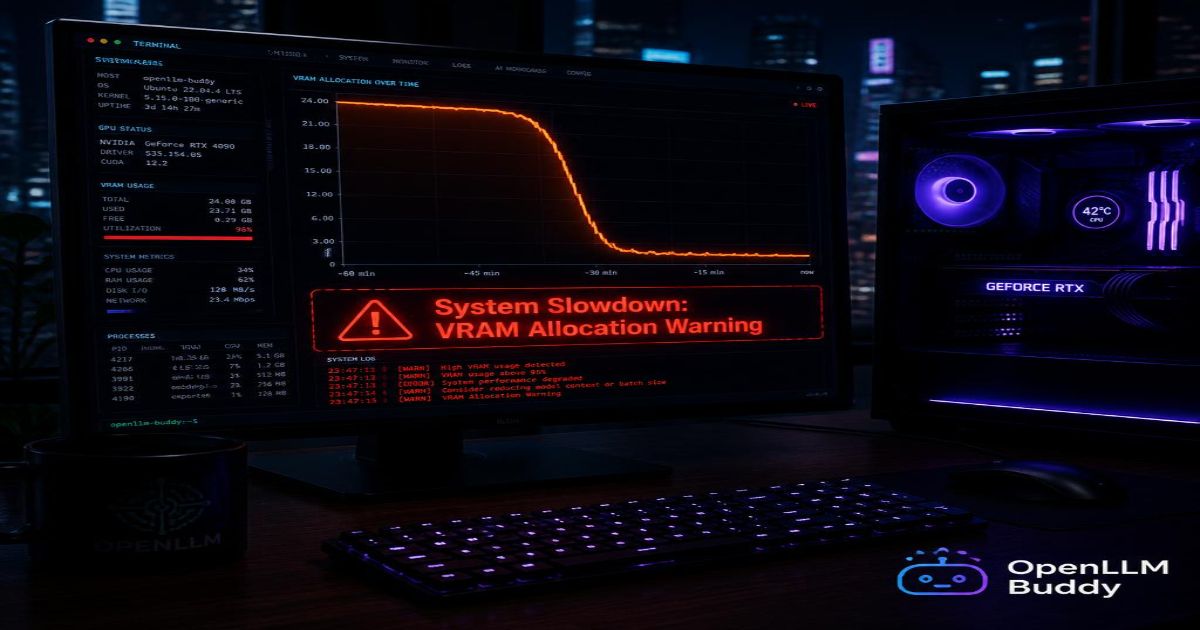
Gemma 4 26B needs 16–18 GB of VRAM just to load the model file. A 50,000-token document passed as context adds another 6–10 GB to the KV Cache — the short-term memory the AI uses to keep track of the document while reading it. On a standard 24 GB GPU, a long document plus a growing conversation history will hit the VRAM ceiling and either crash the process entirely or slow generation to a painful crawl.
OOM warning:
CUDA out of memoryerrors during multi-turn RAG sessions are extremely common on self-hosted 24 GB setups. The first three turns run fine. Turn 7 crashes with no warning and loses the entire conversation state.
4. Zero-Token RAG with OpenLLM Buddy
OpenLLM Buddy was designed specifically to break the RAG cost wall.
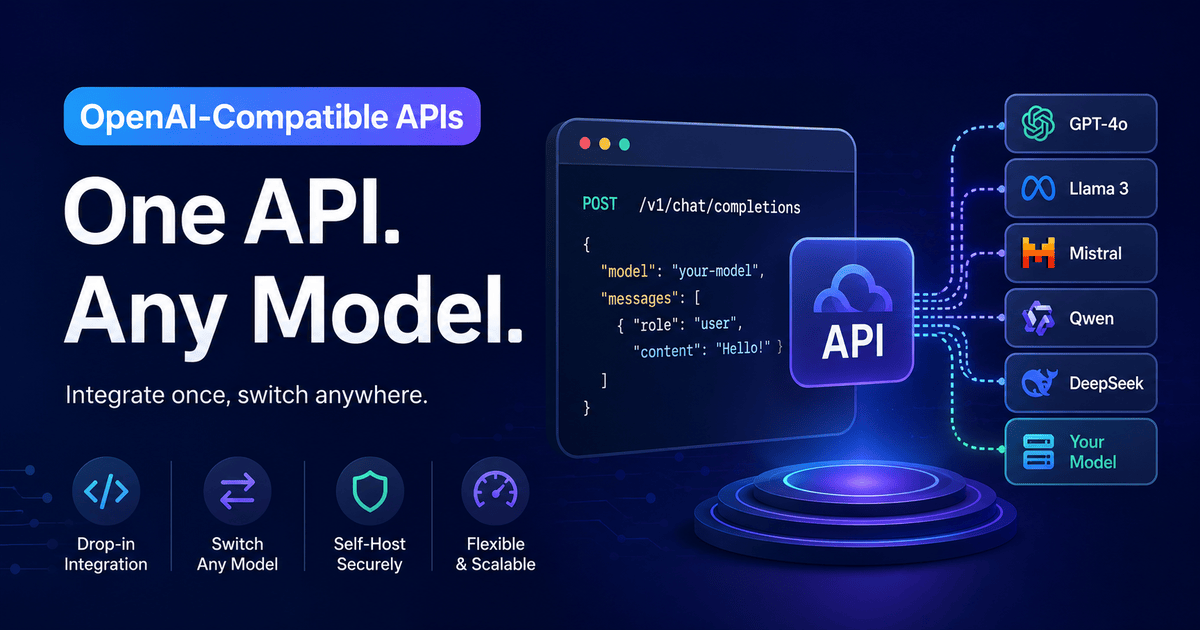
The platform hosts Gemma 4 26B on dedicated NVIDIA RTX 4090 and RTX 5090 hardware via RunPod compute. The KV cache is managed at the platform level — long documents and multi-turn conversation histories don't overflow or crash. You get an instant, OpenAI-compatible API endpoint with no configuration required.
The core difference from every standard API provider: token consumption is completely free. You pay a flat rate for GPU compute time only — not per token, not per document page, not per conversation turn.
That 50,000-token manual read 10 times per conversation? On OpenLLM Buddy, the cost is identical to reading it once. Your RAG system can handle deep, multi-turn document sessions without the bill compounding on every exchange.
Wiring up a LangChain or LlamaIndex RAG pipeline to OpenLLM Buddy takes one line:
import openai

# Full RAG document processing with zero token markup
client = openai.OpenAI(
    base_url="https://api.openllmbuddy.cloud/v1",
    api_key="YOUR_OPENLLM_BUDDY_KEY"
)

# Pass an entire manual as context — no per-token penalty
response = client.chat.completions.create(
    model="gemma-4-26b-a4b",
    messages=[
        {
            "role": "system",
            "content": "You are a helpful assistant. Use this 100-page manual to answer questions: [Insert Manual Text Here]"
        },
        {
            "role": "user",
            "content": "How do we process a product return according to page 45?"
        }
    ],
    temperature=0.1
)

print(response.choices[0].message.content)
Predictable flat-rate pricing:
| Plan | Gemma 4 26B (RTX 4090) | Qwen 3.6 27B (RTX 5090) |
|---|---|---|
| 11 Hours | $10 | $14 |
| 24 Hours | $22 | $31 |
| 1 Week | $150 | $212 |
| 1 Month | $599 | $845 |
Both plans auto-terminate on uptime quota — no overnight idle billing between your document processing runs.
The math: 200 support conversations/day, 10 turns each, 50,000-token manual per session. On a $15/million token API: $1,500/day. On OpenLLM Buddy's 24h flat rate: $22. The break-even happens in under two hours of real usage.
The Honest Verdict
Gemma 4 26B is genuinely one of the best open-weight models for RAG work available today:
- 94% retention accuracy at near-maximum context depth
- 88.3% AIME reasoning — connects clues across multiple document sections reliably
- Native thinking mode — built-in hallucination guard before every response
- 256K context — fits most real-world enterprise documents in a single read
The model itself is excellent. The infrastructure challenge is real. For any serious RAG deployment beyond simple prototypes, per-token billing makes the cost math brutal — and local GPU setups hit VRAM walls in multi-turn sessions.
OpenLLM Buddy removes both problems with a flat daily rate and managed hardware that handles long documents and deep conversation histories without crashing.