Is Gemma 4 26B Good for Coding? Architecture, Benchmarks, and Production Realities
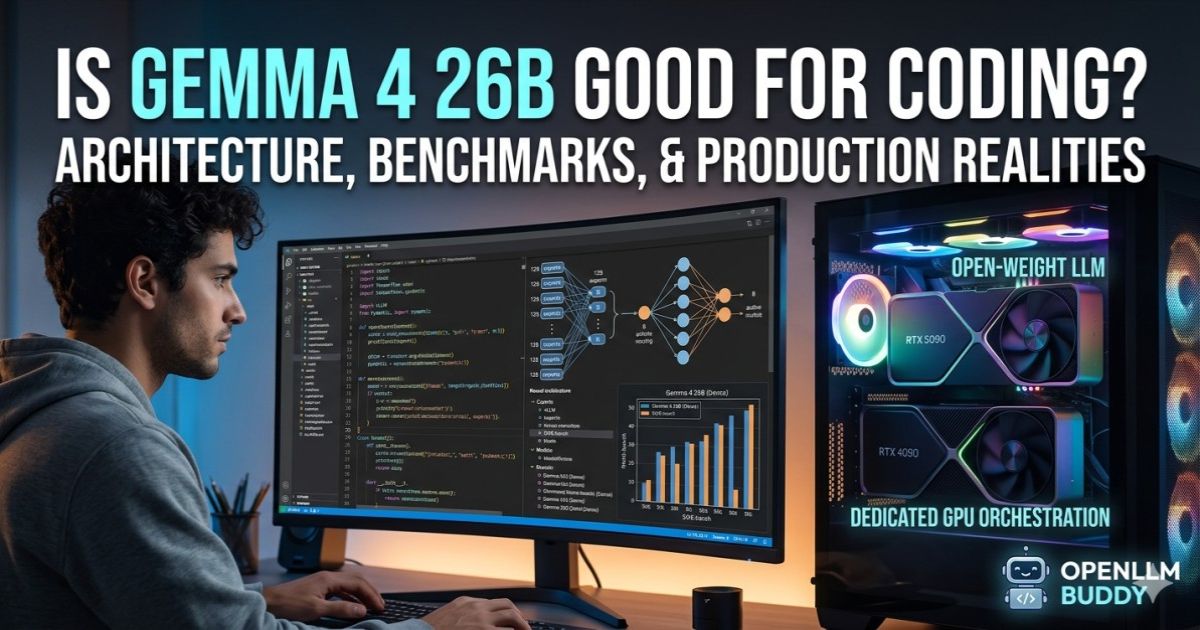
Is Gemma 4 26B Good for Coding? Architecture, Benchmarks, and Production Realities
TL;DR: Gemma 4 26B-A4B is one of the most parameter-efficient coding models ever released open-weight. It scores 77.1% on LiveCodeBench v6 and hits a Codeforces ELO of 1718 — with only 3.8B parameters firing per forward pass. The model is genuinely impressive. The infrastructure to run it in production, however, will eat your weekend. This post covers both truths.
1. The Architecture — Why This Model Is Different
Google DeepMind dropped Gemma 4 on April 2, 2026, shipped under Apache 2.0. No monthly active user caps. No commercial restrictions. Full weights, full freedom.
But the architecture is the real story.
What "26B A4B MoE" Actually Means
Gemma 4 26B A4B is a Mixture-of-Experts (MoE) model:
- The model has 128 small experts baked into its feed-forward layers
- For each token processed, only 8 routed experts + 1 shared expert activate
- That means only 3.8B parameters fire per forward pass
- The remaining ~22B sit dormant — influencing nothing, costing nothing
The result: you get reasoning depth trained across 26B parameters, but inference latency and VRAM pressure close to a 4B model. Running at Q4_K_M quantization, it fits in 14–18 GB of VRAM — single RTX 4090 territory.
Why the 256K Context Doesn't Degrade
Most long-context models suffer a quality cliff past 32–64K tokens. Gemma 4 solves this with two mechanics:
Alternating Attention — every other layer uses sliding window attention (fast, local). The remaining layers use full global attention (expensive, long-range). You pay global attention cost only where it matters.
Dual RoPE — separate positional embeddings for local and global layers, maintaining positional coherence across the full 256K token context window without degradation.
In practice: you can feed it an entire Next.js codebase, a full package-lock.json, three years of commit history — and it won't lose the thread.
2. The Coding Benchmarks — The Actual Numbers
| Benchmark | Gemma 3 27B | Gemma 4 26B A4B | Delta |
|---|---|---|---|
| LiveCodeBench v6 | 29.1% | 77.1% | +165% |
| Codeforces ELO | 110 | 1718 | +1463 pts |
| AIME 2026 (Math) | 20.8% | 88.3% | +325% |
| GPQA Diamond | 42.4% | 82.3% | +94% |
The generational jump is not incremental. A 165% improvement on LiveCodeBench and a Codeforces ELO jump from 110 to 1718 between two consecutive releases is a step-change.
The 26B MoE, activating only 3.8B parameters, beats OpenAI's gpt-oss-120B on GPQA Diamond (82.3% vs 76.2%). A 94-billion-parameter gap in favor of the smaller model.
A Codeforces ELO of 1718 puts it in the Specialist tier — capable of solving Div 2 D/E problems, the kind of algorithmic complexity that trips up most working developers.
Native Agentic Capabilities
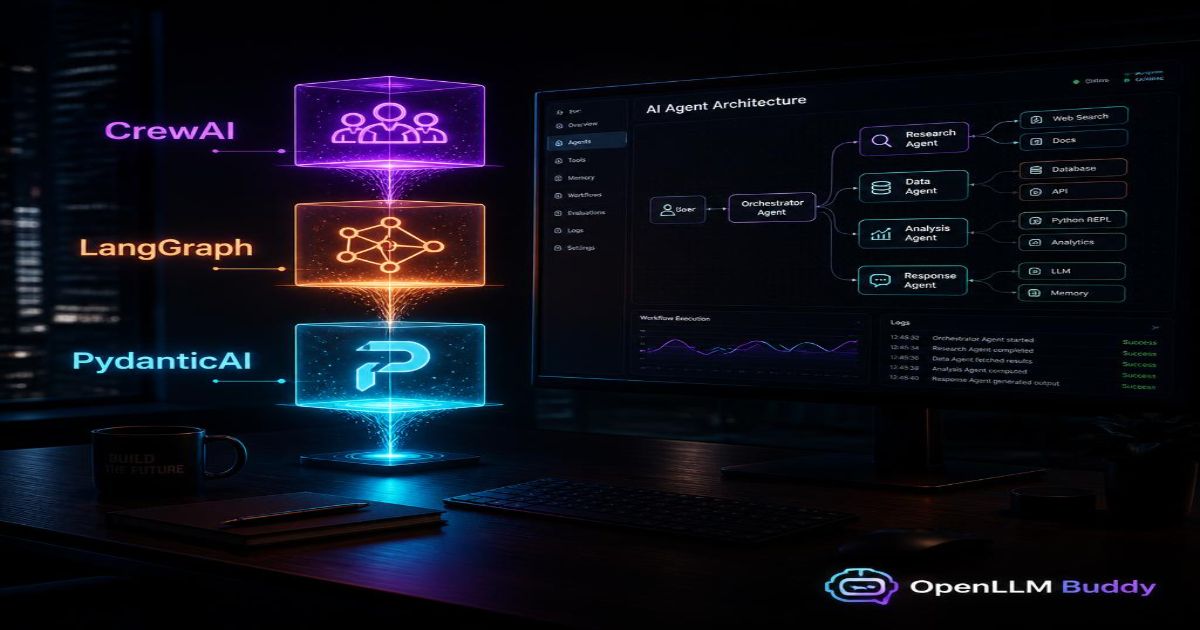
Gemma 4 26B was built for agent workflows, not just autocomplete:
- Native function calling — structured tool invocation without prompt hacks
- Constrained JSON output via structured decoding — reliable schema adherence out of the box
- Multi-step planning — can decompose tasks like "refactor this Express.js auth module" into execution steps and follow through
- Extended thinking mode — generates a full reasoning chain before committing to output, dramatically improving accuracy on hard problems
Drop-in OpenAI SDK example:
from openai import OpenAI

client = OpenAI(
    base_url="https://your-openllmbuddy-endpoint/v1",
    api_key="not-needed"
)

response = client.chat.completions.create(
    model="gemma-4-26b-a4b",
    messages=[
        {"role": "system", "content": "You are a senior engineer. Analyze this codebase and identify security vulnerabilities."},
        {"role": "user", "content": f"Here is the full auth module:\n\n{code_context}"}
    ],
    temperature=0.2
)
The base_url swap is the only code change required from your existing OpenAI setup.
3. The Production Bottleneck — Where Things Get Painful
The Thinking Tax
Gemma 4's extended thinking mode is a genuine capability leap. It's also a hidden billing trap on any serverless, pay-per-token API.
When the model reasons through a complex refactoring task, it generates 4,000–8,000 tokens of internal reasoning before producing its final output. Those tokens are invisible to you — but on a token-priced API, you pay for every single one.
Run the math on a realistic workload:
- You send a 10,000-token context (a Next.js component with tests)
- The model generates 6,000 thinking tokens + 800 output tokens
- You're billed for 16,800 tokens per request
- At $15/million output tokens: $0.25 per call
- An agent running 200 requests/day = $50/day on thinking tokens alone
Scale to a team of five developers and you're burning ~$9,000/month primarily on tokens you never read.
The VRAM and DevOps Trap
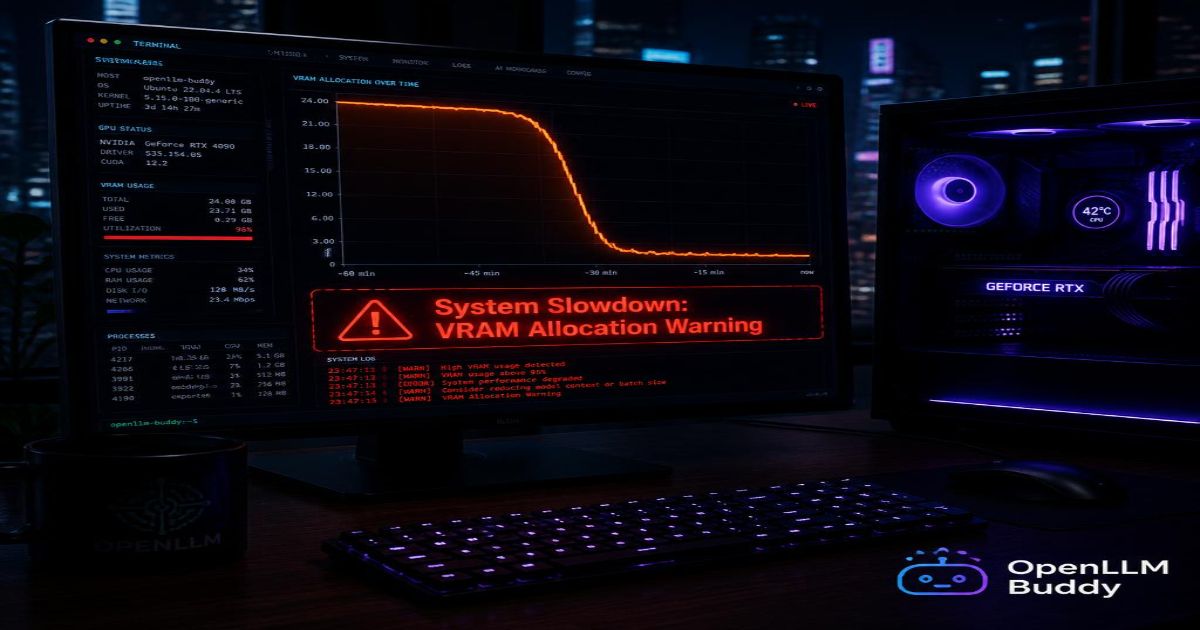
Running it yourself on a raw cloud instance looks attractive on paper. In practice, the 128-expert MoE architecture means naive vLLM configs push peak VRAM to 48 GB — far beyond a single RTX 4090's 24 GB. You either go multi-GPU (expensive and complex) or you configure expert offloading properly, which looks like this:
vllm serve google/gemma-4-26B-A4B-it \
  --tensor-parallel-size 2 \
  --max-model-len 131072 \
  --gpu-memory-utilization 0.90 \
  --enable-chunked-prefill \
  --max-num-batched-tokens 8192
And that's before you've touched KV cache management for 256K context requests, decided between Q4_K_M and Q5_K_M quantization, solved cold-start latency (loading 14–18 GB of weights takes 30–90 seconds), and figured out idle-time billing when no requests are in flight.
For a small dev team shipping a product, this is a part-time infrastructure job that didn't exist in your roadmap. Every hour spent debugging CUDA driver versions is an hour not spent on your actual product.
4. The Solution — OpenLLM Buddy
OpenLLM Buddy was built for exactly this gap: the space between "I want to run Gemma 4" and "I want to debug vLLM configs at midnight."
What the Platform Does
- Handles full MoE orchestration — expert routing pre-optimized for the 128-expert architecture
- Manages VRAM allocation, KV cache, and quantization at the platform level
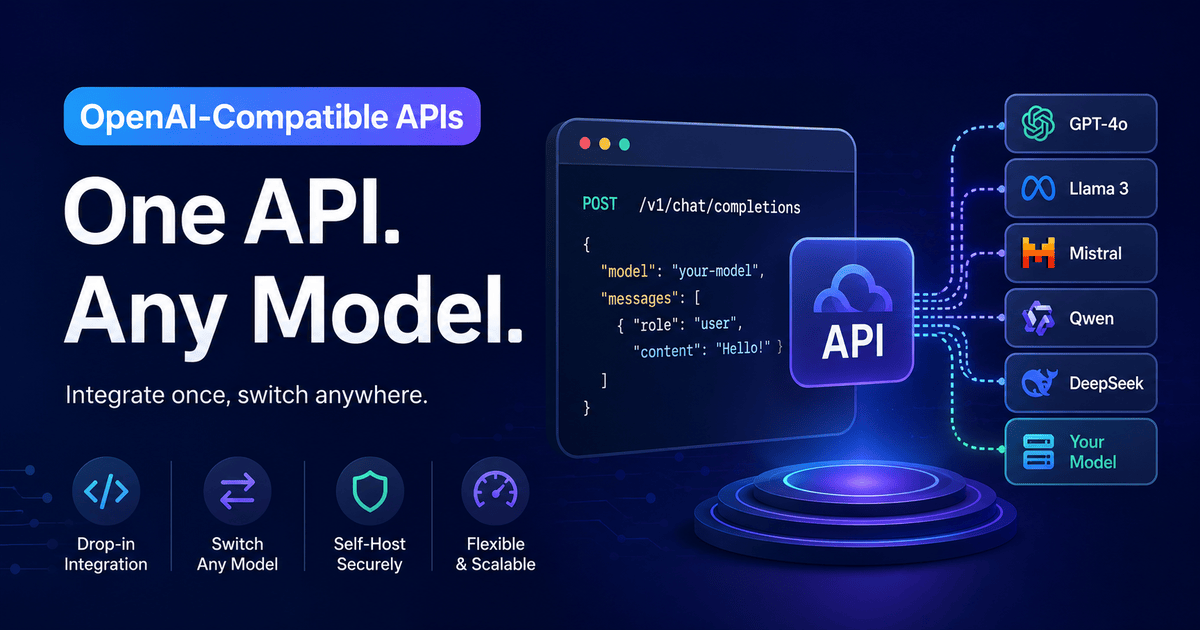
- Delivers a clean, OpenAI-compatible API endpoint — paste the
base_urlinto your existing code and you're live
No CUDA driver debugging. No configuration files. No cold-start architecture decisions on a Sunday.
The Hardware
Gemma 4 26B runs on NVIDIA RTX 4090 (24 GB VRAM) — delivering 112 tok/s max throughput with a 23K context window at Q4_K_M. Fast, stable, production-grade.
The Pricing — This Is Where It Changes
You pay for GPU compute time. Token consumption is completely free. No input token charge. No output token charge. Definitely no thinking token charge.
Real numbers from the platform:
| Plan | Gemma 4 26B (RTX 4090) | Qwen 3.6 27B (RTX 5090) |
|---|---|---|
| 11 Hours | $10 | $14 |
| 24 Hours | $22 | $31 |
| 1 Week | $150 | $212 |
| 1 Month | $599 | $845 |
The 24-hour pack at $22 for Gemma 4 26B gives you 9.67M tokens across 24 hours — and saves you $36.06 compared to Claude Sonnet 4.5 for equivalent usage. The Qwen 3.6 27B on RTX 5090 saves $32.07 vs Opus 4.6. Both plans auto-terminate on uptime quota — you're never billed for idle time you didn't use.
That $0.25-per-call thinking tax? Completely gone. You run 10,000 inference calls with 6,000 thinking tokens each and pay the same flat rate regardless.
Same migration, one line of code:
// Next.js / Node.js
import OpenAI from "openai";

const client = new OpenAI({
  baseURL: "https://your-openllmbuddy-endpoint/v1",
  apiKey: "not-needed",
});

const completion = await client.chat.completions.create({
  model: "gemma-4-26b-a4b",
  messages: [{ role: "user", content: prompt }],
});
LangChain, LangGraph, n8n — same pattern. Swap base_url, keep everything else.
Who This Actually Makes Sense For
To be straight with you — not every workload needs Gemma 4 26B on dedicated hardware.
It's the right call if you're:
- Running an AI coding agent that makes 100+ LLM calls per day
- Building on n8n automation workflows where token usage compounds fast
- Processing long codebases or documents regularly (the 256K context earns its value here)
- A startup that can't afford per-token billing to spiral unpredictably as you scale
It's probably overkill if you're:
- Doing occasional one-off generations with low volume
- Just prototyping and not yet in production
For everyone in the first bucket, the math is straightforward. Flat GPU compute at $22/24h beats per-token pricing the moment your workload gets serious.
The Bottom Line
Gemma 4 26B-A4B is the most capable open-weight coding model in its compute class right now. 77.1% LiveCodeBench, 1718 Codeforces ELO, 256K context, Apache 2.0 — all on a model that runs like a 4B at inference time. The jump from Gemma 3 to Gemma 4 isn't incremental — it's a full architectural rethink that actually delivers on the benchmarks.
Its biggest strength — extended thinking mode — is also its biggest cost trap on token-priced infrastructure. That trap gets worse the better you use the model. The more reasoning you unlock, the more invisible tokens accumulate on your bill.
Stop paying the thinking tax to serverless giants.
Spin up a dedicated Gemma 4 26B instance on an RTX 4090 at OpenLLM Buddy for $22/24 hours. 9.67M tokens. Zero token charges. Auto-terminates when your quota is used — no idle billing surprises. One base_url swap away from your existing OpenAI SDK setup.
The model is ready. The hardware is waiting. The only question is whether you keep paying per token for thoughts you never read.