Is Gemma 4 26B Good for AI Agents? Architecture, Multi-Step Workflows, and Production Costs
Is Gemma 4 26B Good for AI Agents? Architecture, Multi-Step Workflows, and Production Costs
TL;DR: Gemma 4 26B-A4B scores 88.3% on AIME 2026 and 82.6% on MMLU Pro with only 3.8B active parameters per forward pass. Its native function calling, structured JSON output, and 256K context window make it one of the most capable open-weight models for agentic pipelines today. But running it in production without the right infrastructure will either bankrupt you on token bills or bury your team in DevOps debt. This post covers the architecture, the benchmarks, and the infrastructure path that actually works.
1. Defining the Agentic Landscape with Gemma 4
Google DeepMind released Gemma 4 26B-A4B on April 2, 2026 — and for the autonomous agent developer community, the licensing change matters as much as the architecture.
Previous open-weight releases often came with community licenses: Monthly Active User caps, acceptable-use restrictions, commercial barriers that made building a real product feel like navigating legal landmines. Gemma 4 ships under Apache 2.0 — fully permissive, no MAU caps, no usage restrictions, complete commercial freedom. You can build a production agent product on top of it today with no gotcha clauses waiting for you at scale.
Chatbots vs. Agents — Why the Distinction Matters
Most developers start with chatbots. A chatbot is stateless: it takes a prompt, returns a response, and forgets everything. The infrastructure bar is low because each call is independent.
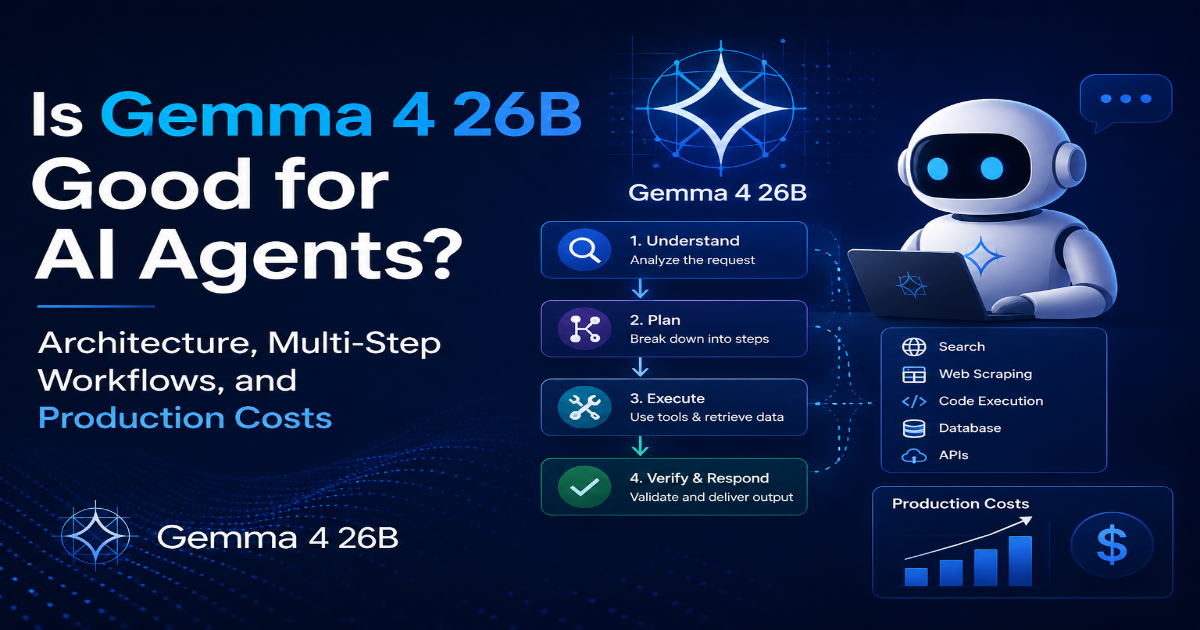
Agentic AI is fundamentally different. An autonomous agent operates in a continuous execution loop:
- Perception — it reads tool outputs, web pages, code execution results, database states
- Planning — it decomposes a high-level goal into a sequence of executable sub-tasks
- Memory persistence — it tracks prior actions and their outcomes across dozens or hundreds of steps
- Tool invocation — it calls external APIs, runs bash commands, queries vector stores, writes and executes code
A single agent task might involve 50–200 LLM calls, accumulating context across the entire run. The model needs to stay coherent across that entire chain — not just answer a single question well.
The Architecture That Makes This Possible
Gemma 4 26B-A4B is a Mixture-of-Experts (MoE) model with a specific routing design that benefits agents directly:
- 128 small feed-forward experts in the model's architecture
- Per token, only 8 routed experts + 1 shared expert activate
- Result: only 3.8B parameters fire per forward pass
- You get the reasoning depth of a 25B+ dense model at the inference latency of a small model
For agentic workloads where you're calling the model hundreds of times per task, inference speed and efficiency compound directly into total task completion time. A model that computes like a 4B but reasons like a 25B+ is purpose-built for high-frequency agent loops.
2. Deep-Dive: Agent-Centric Benchmarks and Features
Benchmarks matter here, but only the right ones. For agents, you care about reasoning depth, tool use accuracy, and long-context coherence — not just chat quality.
The Hard Numbers
| Benchmark | Gemma 4 26B A4B | What It Measures |
|---|---|---|
| MMLU Pro | 82.6% | Multi-domain expert reasoning |
| AIME 2026 | 88.3% | Deep multi-step math reasoning (no tools) |
| GPQA Diamond | 82.3% | Graduate-level scientific problem solving |
| LiveCodeBench v6 | 77.1% | Real competitive programming |
| τ²-bench Agentic Tool Use | 86.4% | Multi-step tool invocation accuracy |
The AIME 2026 score of 88.3% — achieved without external tool assistance — is the clearest signal of raw reasoning depth. AIME problems require chained logical deductions across 10–15 steps. A model that solves them reliably is exactly the kind of planner you want running your agent's task decomposition layer.
The τ²-bench agentic tool use score of 86.4% is the most directly relevant for agent builders. Gemma 3 27B scored 6.6% on the same benchmark. That is not a marginal improvement — it is a generation shift in how reliably the model executes multi-step tool calls.
Native Features Built for Autonomous Agents
Native Function Calling
Gemma 4 26B supports structured tool invocation natively — no prompt engineering hacks, no XML-wrapped tool schemas, no brittle regex parsing. When you define a tool signature, the model calls it with syntactically correct arguments. At agent scale, where one malformed function call can corrupt an entire pipeline run, this reliability is not optional.
Structured JSON Output via Constrained Decoding
Agents that write to databases, call REST APIs, or pass state between pipeline steps need to output valid schemas — every single time. Gemma 4's constrained decoding guarantees schema adherence at the token level. The model physically cannot produce invalid JSON when constrained output mode is active.
Visual and UI Parsing
This is an underappreciated capability for browser automation agents. Gemma 4 26B can output exact bounding box coordinates for UI elements in images — buttons, form fields, navigation items. Feed it a screenshot of a web interface and it can return the precise [x1, y1, x2, y2] coordinates for the element your agent needs to interact with. This makes it a strong engine for playwright-based or selenium-based browser automation without external vision models.
The 256K Context Window — Without the Quality Cliff
Most long-context models degrade badly past 32K–64K tokens. Gemma 4 solves this architecturally:
- Alternating Attention at a 5:1 ratio — five sliding window attention layers (local, fast, efficient) for every one full global attention layer (expensive, long-range). You get long-range coherence without paying global attention cost on every layer.
- Dual RoPE — separate rotary position embeddings for local and global attention layers, maintaining precise positional encoding across the full 256K window.
For an agent running a 100-step loop on a large codebase, the model genuinely retains context from step 1 when it reaches step 100. That is not something you can assume with most models at that depth.
3. The Production Reality — Where the Pain Lives
The benchmarks are real. The infrastructure problem is equally real.
The Thinking Tax
Gemma 4's extended thinking mode is what drives those AIME and τ²-bench scores. When the model plans a complex agent action, it generates an internal reasoning chain before committing to an output — often 4,000 to 8,000 tokens of hidden cognition per planning step.
Those tokens never appear in your response. You never read them. But on any serverless, pay-per-token API:
You are billed for every single internal reasoning token the model generates — whether you see them or not.
Run the math on a realistic overnight background agent:
- Agent runs 150 planning steps across a long task
- Each step: 8,000-token context + 5,000 thinking tokens + 400 output tokens
- Billable tokens per step: 13,400
- Total billable tokens for the run: ~2,000,000
- At $15/million output tokens (a common serverless rate): $30 for a single overnight run
- Five agents running simultaneously, five nights a week: $3,750/month — on thinking tokens alone
And that's a conservative estimate. A 256K context window means agents working on large codebases or document corpora can accumulate context far faster than this.
The DevOps Trap
The natural response is to self-host. Rent a GPU instance, deploy vLLM, and eliminate the per-token billing. In practice, this trades one problem for three:
Cold start latency — Loading Gemma 4 26B at Q4_K_M quantization (14–18 GB of weights) from disk takes 30–90 seconds. An agent pipeline that needs to scale up from zero faces a cold start penalty on every new instance.
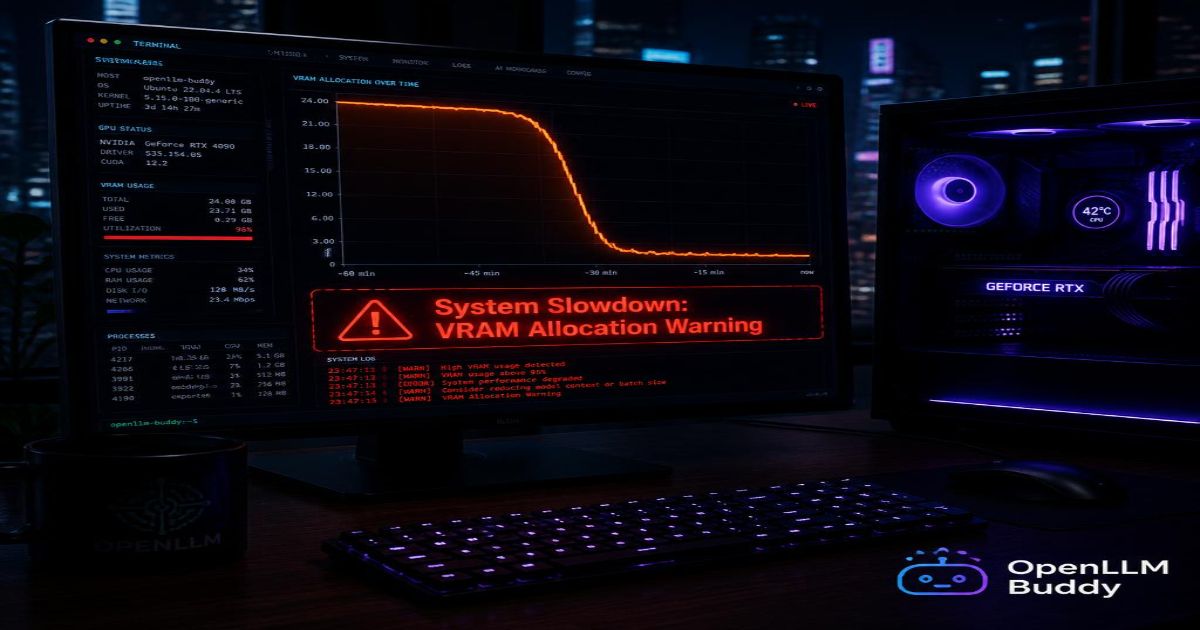
Idle VRAM waste — A bare GPU instance charges you whether it's processing requests or sitting idle at 2 AM. A 24/7 reserved RTX 4090 costs money even when your agents are sleeping. The economics only work if utilization stays high — which background agent workloads rarely guarantee.
MoE routing complexity — The 128-expert architecture requires careful vLLM configuration to avoid VRAM overflow. Without explicit expert offloading parameters, naive deployments push peak VRAM usage to 48 GB — far beyond a single GPU's capacity:
# What you're dealing with without managed infrastructure
vllm serve google/gemma-4-26B-A4B-it \
  --tensor-parallel-size 2 \
  --max-model-len 262144 \
  --gpu-memory-utilization 0.90 \
  --enable-chunked-prefill \
  --max-num-batched-tokens 8192 \
  --disable-log-requests
Two GPUs in tensor parallel, manual chunked prefill configuration, VRAM utilization tuning — and that's the start of the configuration, not the end of it. For a small software team, this is a part-time infrastructure role that competes directly with product development.
4. The Solution — Scaling Agents with OpenLLM Buddy
OpenLLM Buddy is the infrastructure layer built to close this gap. It handles the full MoE orchestration, deployment, and scaling layer natively — so you get a production-ready, OpenAI-compatible API endpoint without touching a single vLLM configuration file.
What the Platform Handles For You
- Full 128-expert MoE routing optimized at the platform level — no VRAM overflow, no manual tensor parallelism configuration
KVcache management pre-tuned for long 256K context agent runs- Auto-termination on uptime quota — you are never billed for idle time between agent runs
- Clean
OpenAI-compatible endpoint — drop into any existingLangChain,CrewAI, orAutoGensetup with a single line change
The Hardware
Your agents run on NVIDIA RTX 4090 (delivering 112 tok/s throughput for Gemma 4 26B) and next-generation RTX 5090 hardware — hosted on RunPod compute. Not shared, throttled, serverless instances. Dedicated silicon.
The Pricing Model — This Is the Core Difference
Token consumption is completely free. You pay only for GPU compute time.
No input token charge. No output token charge. No thinking token charge. No surprise invoice because your agent's reasoning loop ran deeper than expected.
| Plan | Gemma 4 26B (RTX 4090) | Qwen 3.6 27B (RTX 5090) |
|---|---|---|
| 11 Hours | $10 | $14 |
| 24 Hours | $22 | $31 |
| 1 Week | $150 | $212 |
| 1 Month | $599 | $845 |
That overnight agent run generating 2,000,000 billable tokens on a serverless API? On OpenLLM Buddy, it costs the same flat rate as any other 24-hour run — $22, regardless of token volume.
Migrating Your Agent Framework — One Line of Code
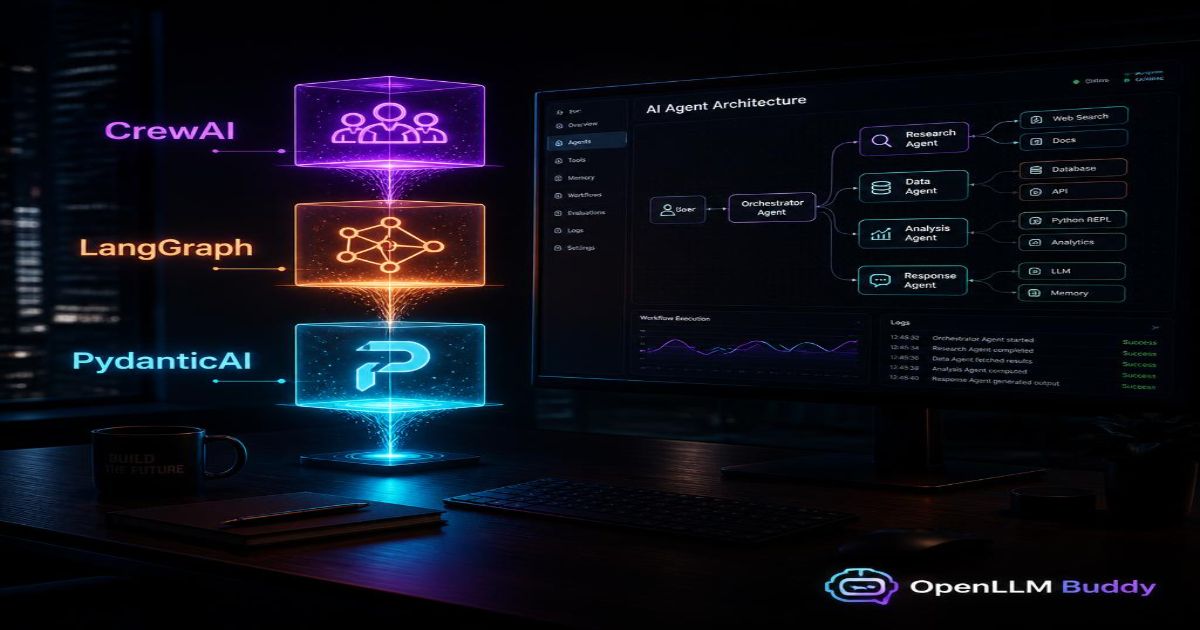
If you're using LangChain, CrewAI, or AutoGen, the migration is a single base_url swap. No SDK changes. No prompt rewrites. No agent logic modifications.
LangChain:
from langchain_openai import ChatOpenAI

llm = ChatOpenAI(
    base_url="https://your-openllmbuddy-endpoint/v1",
    api_key="not-needed",
    model="gemma-4-26b-a4b",
    temperature=0.1,
)

# Drop directly into any existing LangGraph or LangChain agent
agent = create_react_agent(llm, tools=your_tools)
CrewAI:
from crewai import LLM

llm = LLM(
    model="openai/gemma-4-26b-a4b",
    base_url="https://your-openllmbuddy-endpoint/v1",
    api_key="not-needed",
)

# Pass to any CrewAI Agent — zero other changes
researcher = Agent(role="Senior Researcher", llm=llm, tools=[search_tool])
AutoGen:
from autogen import AssistantAgent

config = {
    "model": "gemma-4-26b-a4b",
    "base_url": "https://your-openllmbuddy-endpoint/v1",
    "api_key": "not-needed",
}

assistant = AssistantAgent(name="coder", llm_config={"config_list": [config]})
Every framework. Same pattern. One URL. Your agent logic stays exactly as-is.
The Endgame
If your autonomous worker needs to process millions of context tokens — loading an entire codebase, analyzing a document corpus, running a 200-step reasoning loop overnight — you pay for the runtime of the silicon, and nothing else.
No per-token metering. No hidden thinking-token surcharges. No bill that scales with how deeply your model thinks. The platform auto-terminates when your quota expires, so there is no idle bleed between runs either.
The Bottom Line
Gemma 4 26B-A4B is the strongest open-weight foundation for production AI agents available today. The MoE architecture gives you dense-model reasoning at small-model inference speed. The native function calling, constrained JSON output, and 256K context window are not afterthoughts — they are core capabilities built for exactly the kind of continuous loop execution that autonomous agents require.
The infrastructure problem is real. Token billing at agent scale compounds fast. Self-hosting the 128-expert MoE on bare cloud instances introduces DevOps complexity that eats your engineering bandwidth.
Stop letting your infrastructure bottleneck your agents.
Deploy on dedicated RTX 4090 hardware at OpenLLM Buddy — $22 for 24 hours, 9.67M tokens included, zero token charges, one base_url swap from your existing stack. Your agents think as deeply as the task demands. Your bill stays flat.
The silicon is waiting.